North Carolina Dog Registration Information
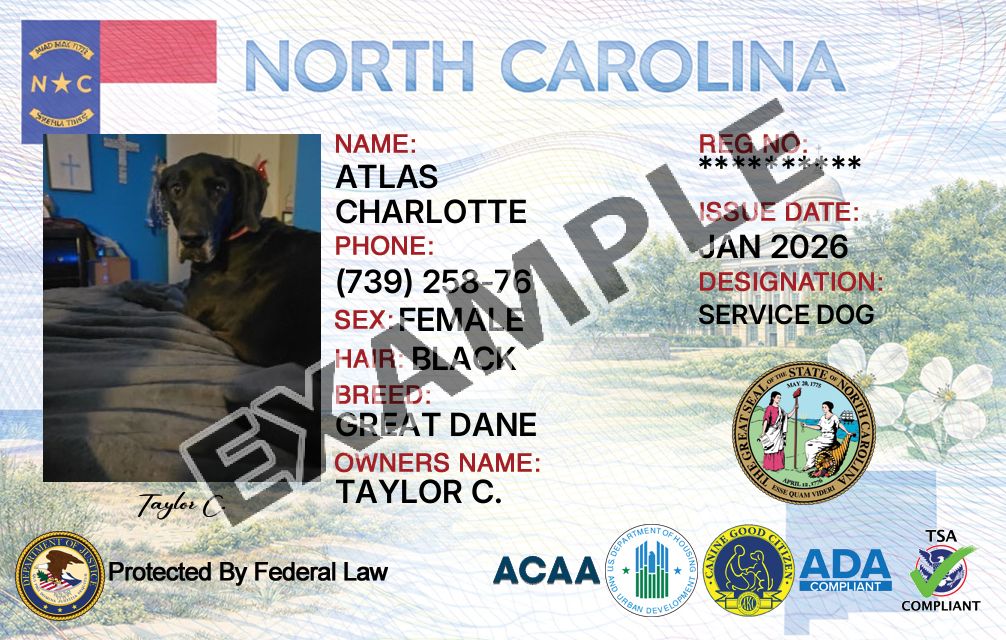
State Licensed, Service Dogs and Emotional Support Dogs in North Carolina
Overview of Dog Licensing in North Carolina
If you’re searching where do I register my dog in North Carolina for my service dog or emotional support dog, the most important thing to know is this: in North Carolina, there usually isn’t a single statewide “service dog registry” or “emotional support dog registration” run by the state. Instead, what most people mean by “registering” a dog is getting the dog licensed locally (often tied to rabies vaccination) through the county or city agency that handles animal control and rabies enforcement.
This page explains how a dog license in North Carolina typically works, why animal control dog license North Carolina rules are often local, what North Carolina rabies rules require, and the legal difference between a dog license, a service dog, and an emotional support animal.
Where to Register or License Your Dog in North Carolina
Because where to register a dog in North Carolina is usually determined by your county (and sometimes city), you’ll typically start with your local Animal Services / Animal Control office. These offices commonly administer rabies-related enforcement, sell rabies tags, and provide guidance on any local licensing requirements. Below are several example official offices in North Carolina to illustrate the kind of agency you may need to contact in your area.
City of Charlotte (CMPD) Animal Care & Control — Main Shelter
Address: 8315 Byrum Drive
City/State/ZIP: Charlotte, NC 28217
Hours:
Monday–Friday: 11:00 a.m. – 7:00 p.m.
Saturday–Sunday: 9:00 a.m. – 5:00 p.m.
Phone: Not listed on the official office listing used for this page
Guilford County Animal Services
Address: 980 Guilford College Road
City/State/ZIP: Greensboro, NC 27409
Hours (open to the public):
Sunday, Monday, Wednesday, Thursday, Friday, Saturday: 12:00 p.m. – 4:00 p.m.
Closed Tuesday
Phone: 336-641-3400
Email: GCASInfo@guilfordcountync.gov
Animal Control (phone): 336-641-5990
Animal Control hours: Monday–Saturday, 8:00 a.m. – 5:00 p.m.
Forsyth County Animal Shelter
Address: 5570 Sturmer Park Circle
City/State/ZIP: Winston-Salem, NC 27105
Phone: 336-703-2480
Email: shelter@forsyth.cc
Hours of operation (as posted):
Sunday: Closed
Monday: Closed
Tuesday: 12:00 p.m. – 4:00 p.m.
Wednesday: 12:00 p.m. – 4:00 p.m.
Thursday: 12:00 p.m. – 4:00 p.m.
Friday: 12:00 p.m. – 4:00 p.m.
Saturday: 12:00 p.m. – 4:00 p.m.
Tip for Finding Your Correct Office
If your county office is not listed above, search your county’s official website for: “Animal Services,” “Animal Control,” “Rabies,” or “Rabies tag”. In many places, that is the office that can tell you exactly how to obtain a local license or tag.
If you live inside a city with its own animal control department, ask whether the city or the county is the primary agency for licensing/rabies tags in your jurisdiction.
How Dog Licensing Works Locally in North Carolina
1) “Dog license” is usually a local program (county/city)
North Carolina does not operate a single, statewide dog licensing counter for all residents. Instead, dog license in North Carolina requirements are commonly established and administered by local governments. That’s why many people end up calling their animal control dog license North Carolina office (or county Animal Services) to ask where and how to pay a fee, get a tag, or update owner information.
In practice, many counties connect “licensing” to rabies control: they may issue or sell a county tag (or record) based on proof that your dog’s rabies vaccination is current. Some counties also require an annual renewal or a fee schedule that varies by spay/neuter status, age, or residency zone.
2) Rabies vaccination is a statewide requirement (with local enforcement)
North Carolina public health guidance emphasizes that state law requires dogs (and also cats and ferrets) to be currently vaccinated against rabies beginning at four months of age. Local animal control officers enforce these requirements in their jurisdictions, and local ordinances can add practical details (like how tags are issued, replacement tags, or citations).
3) Rabies tags and “registration” are not the same as training or certification
A rabies tag (or local license tag) is primarily about public health and identification. It helps show that the dog has a current rabies vaccination and that the dog can be traced to an owner if found. It does not certify that a dog is a service animal, does not provide public access rights, and does not replace training or behavior standards.
4) If you just moved, you may need to update your county record
If you relocated within North Carolina, the place you “register” is typically the county you live in now. If you moved from another state, you’ll usually need: proof of current rabies vaccination from a veterinarian and any local paperwork/fee your county requires for a new or transferred record.
Overview of Dog Licensing in North Carolina
Common terms you’ll hear (and what they usually mean)
| Term | What it usually refers to in North Carolina | What it does not mean |
|---|---|---|
| Dog license | A local county/city licensing record (often linked to rabies vaccination proof) and sometimes an annual or periodic fee. | Not a service dog certification or emotional support designation. |
| Rabies tag | A tag issued when rabies vaccine is administered (and/or a tag recognized locally to show current vaccination). | Not proof of specialized training or disability-related work. |
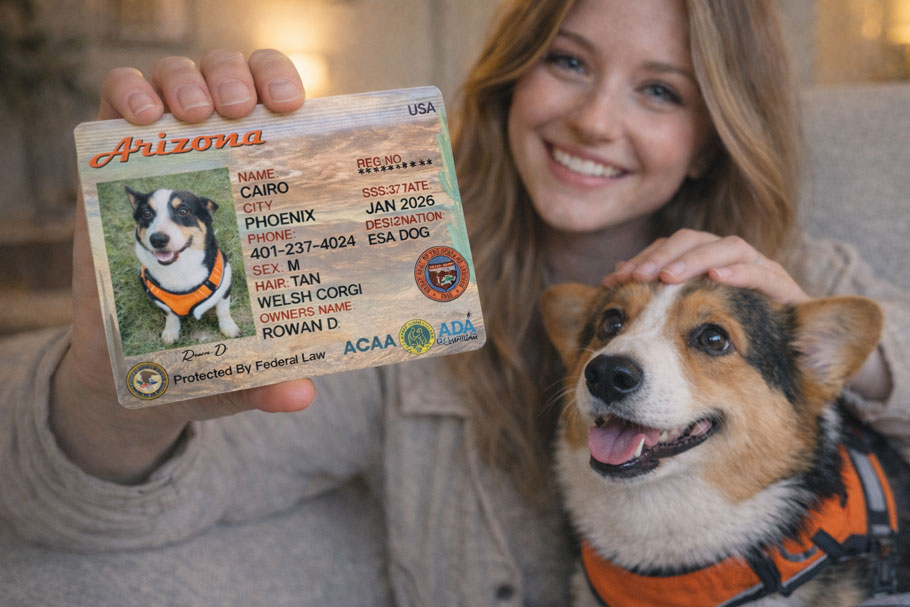
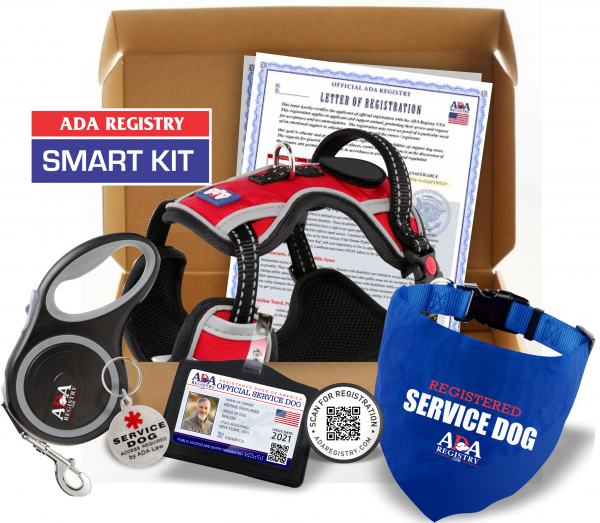
| Service dog | A dog individually trained to do work or perform tasks for a person with a disability (public access rights depend on meeting this definition and behavior standards). | Not established by purchasing an ID card, certificate, vest, or “registry” listing. |
| Emotional support animal (ESA) | An animal that provides comfort/support that may be recognized in certain housing contexts when supported by appropriate documentation. | Not a service animal for public access in most settings. |
What to expect when you ask “where do I register my dog?”
When someone asks where to register a dog in North Carolina, the best answer is usually: start with your local county Animal Services/Animal Control office (or your city’s animal control department if your city runs its own). They can tell you whether your county issues a license, whether the license is mandatory, what the renewal schedule is, and what documentation you must bring or upload.
What agencies are responsible (state vs. local)
In North Carolina, rabies is treated as a public health issue, with state-level public health guidance and statutes setting core requirements, while county animal control officers and local animal services departments handle day-to-day enforcement and local licensing/tag programs. In other words: the state sets key rabies rules, but the “licensing desk” is usually local.
Service Dog Laws in North Carolina
Service dog status is legal/functional — not a registration
A service dog is defined by what the dog is trained to do for a person with a disability (for example, guiding, alerting, retrieving, interrupting a medical episode, or other trained tasks). Service dog recognition does not typically depend on signing up for a registry, buying paperwork online, or paying for a “certification.”
That’s why there is no single place you “register your dog as a service dog” with the State of North Carolina in order to create public access rights. You may still need local licensing/rabies compliance like any other dog, but that is separate from service-dog legal status.
You may still need a local dog license and rabies compliance
Even if your dog is a service dog, local rules about a dog license in North Carolina (county-issued) and rabies vaccination can still apply. In many counties, if an officer or shelter needs to identify a dog quickly, the rabies/license tag and the county record help reunite dogs with their handlers.
Practical tip: keep documentation organized (even if not “registration”)
For day-to-day life, it helps to keep (1) your dog’s rabies vaccination certificate, (2) any local license receipt/tag info, and (3) veterinary records in one place. If there’s a dispute about vaccination status, these records are often what local offices request.
Emotional Support Animal Rules in North Carolina
An ESA is different from a service dog
An emotional support animal (ESA) generally provides comfort by its presence, but it is not necessarily trained to perform specific disability-related tasks. Because of that difference, ESAs typically do not receive the same broad public-access rights as service dogs.
“Registering” an ESA is usually not a government process
If you are asking where do I register my dog in North Carolina for my service dog or emotional support dog, it’s important to separate: local licensing/rabies (government offices) from ESA documentation (often handled through housing processes and appropriate professional documentation).
Regardless of whether your dog is an ESA, your dog may still need a local license/tag and must meet rabies vaccination requirements. So the “registration” step with a government office is usually still the same: contact your county/city Animal Services or Animal Control office for licensing/rabies tag rules.
Frequently Asked Questions
Start with your county Animal Services / Animal Control office. In many parts of the state, that county office is the agency that handles local licensing records, rabies enforcement, and guidance on tags and fees. This is the most consistent answer to where to register a dog in North Carolina.
Not always. A rabies tag shows rabies vaccination status and is part of rabies control; a local license may be an additional county/city requirement that can involve a fee and a local record. Some jurisdictions effectively tie these together, while others treat them separately. Your local animal control dog license North Carolina office can confirm how your county handles it.
Generally, no. Service dog status is typically based on disability-related need and the dog’s training to perform tasks/work, not on joining a state registry. However, you may still need the same local compliance as any other dog (rabies vaccination and any local licensing rules).
Typically, no special government-issued “ESA license” exists for public access. ESAs may be relevant in specific contexts (often housing), but local dog licensing and rabies requirements still apply like any other dog.
If you’re inside a city, the city may run Animal Control (or contract it), while the county may still manage rabies-related programs. Call either the city’s Animal Control/Animal Care & Control office or the county Animal Services office and ask: “Who handles dog licensing and rabies tags for my address?” They can direct you to the correct department.
Bottom line
If your question is where do I register my dog in North Carolina for my service dog or emotional support dog, the government “registration” step is usually the same regardless of service/ESA status: comply with rabies vaccination and follow your local county/city dog licensing process through Animal Services/Animal Control.
What You May Need
- rabies vaccination proof
- identification
- proof of residency
- licensing fee
Quick Checklist for Calling Your Local Office
- Ask whether your county/city requires a dog license in addition to rabies compliance.
- Ask how to replace a lost rabies tag or license tag.
- Ask whether licensing is annual or based on the rabies vaccination expiration date.
- Ask what name/address changes require an update to the record.
Register A Dog In Other North Carolina Counties
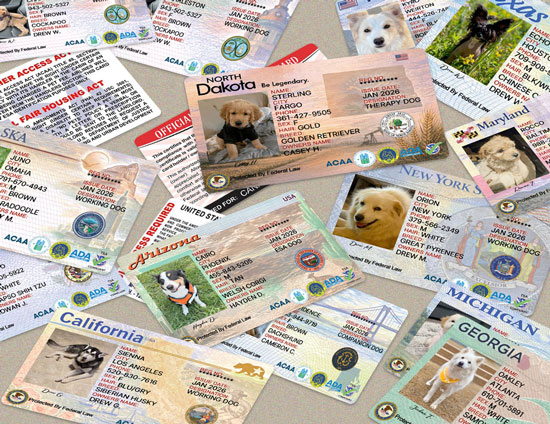
Select your county from the dropdown below to get started with your dog’s ID card. Requirements and license designs may vary by county, so choose your location to see the correct options and complete your pup’s registration.
- Alamance County Dog Registration
- Alexander County Dog Registration
- Alleghany County Dog Registration
- Anson County Dog Registration
- Ashe County Dog Registration
- Avery County Dog Registration
- Beaufort County Dog Registration
- Bertie County Dog Registration
- Bladen County Dog Registration
- Brunswick County Dog Registration
- Buncombe County Dog Registration
- Burke County Dog Registration
- Cabarrus County Dog Registration
- Caldwell County Dog Registration
- Camden County Dog Registration
- Carteret County Dog Registration
- Caswell County Dog Registration
- Catawba County Dog Registration
- Chatham County Dog Registration
- Cherokee County Dog Registration
- Chowan County Dog Registration
- Clay County Dog Registration
- Cleveland County Dog Registration
- Columbus County Dog Registration
- Craven County Dog Registration
- Cumberland County Dog Registration
- Currituck County Dog Registration
- Dare County Dog Registration
- Davidson County Dog Registration
- Davie County Dog Registration
- Duplin County Dog Registration
- Edgecombe County Dog Registration
- Forsyth County Dog Registration
- Franklin County Dog Registration
- Gaston County Dog Registration
- Gates County Dog Registration
- Graham County Dog Registration
- Granville County Dog Registration
- Greene County Dog Registration
- Guilford County Dog Registration
- Halifax County Dog Registration
- Harnett County Dog Registration
- Haywood County Dog Registration
- Henderson County Dog Registration
- Hertford County Dog Registration
- Hoke County Dog Registration
- Hyde County Dog Registration
- Iredell County Dog Registration
- Jackson County Dog Registration
- Johnston County Dog Registration
- Jones County Dog Registration
- Lee County Dog Registration
- Lenoir County Dog Registration
- Lincoln County Dog Registration
- Macon County Dog Registration
- Madison County Dog Registration
- Martin County Dog Registration
- McDowell County Dog Registration
- Mecklenburg County Dog Registration
- Mitchell County Dog Registration
- Montgomery County Dog Registration
- Moore County Dog Registration
- Nash County Dog Registration
- New Hanover County Dog Registration
- Northampton County Dog Registration
- Onslow County Dog Registration
- Orange County Dog Registration
- Pamlico County Dog Registration
- Pasquotank County Dog Registration
- Pender County Dog Registration
- Perquimans County Dog Registration
- Person County Dog Registration
- Pitt County Dog Registration
- Polk County Dog Registration
- Randolph County Dog Registration
- Richmond County Dog Registration
- Robeson County Dog Registration
- Rockingham County Dog Registration
- Rowan County Dog Registration
- Rutherford County Dog Registration
- Sampson County Dog Registration
- Scotland County Dog Registration
- Stanly County Dog Registration
- Stokes County Dog Registration
- Surry County Dog Registration
- Swain County Dog Registration
- Transylvania County Dog Registration
- Tyrrell County Dog Registration
- Union County Dog Registration
- Vance County Dog Registration
- Wake County Dog Registration
- Warren County Dog Registration
- Washington County Dog Registration
- Watauga County Dog Registration
- Wayne County Dog Registration
- Wilkes County Dog Registration
- Wilson County Dog Registration
- Yadkin County Dog Registration
- Yancey County Dog Registration